Missing Voices, Broken Messages: The Case for Producer-Led Agricultural Communications
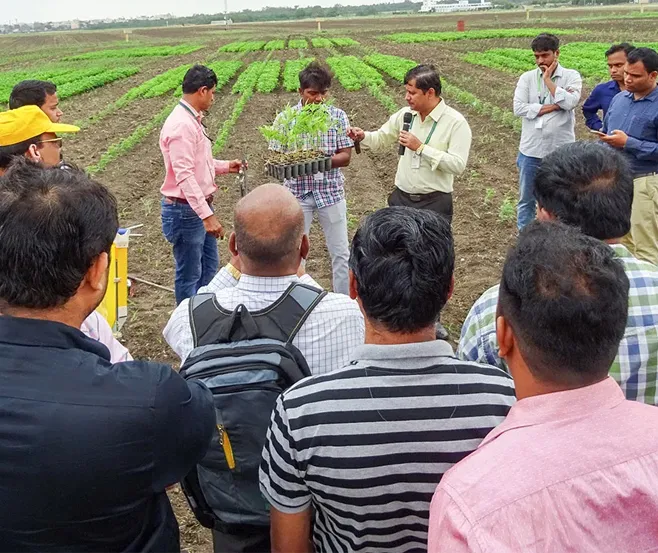
Photo: farmer meeting agricultural advisory discussion rural community, via sahasracropscience.com
There is a particular kind of communications failure that is endemic to the agricultural sector, and it tends to go unexamined precisely because it happens at the organizational level where most decisions are made. It occurs when a company—an ag-tech firm, a supply chain aggregator, a sustainability initiative with genuine intentions—develops a public narrative about farming without substantively involving the farmers that narrative is meant to represent.
The results are predictable to anyone who has spent time in rural agricultural communities. Messaging that sounds fluent in corporate sustainability but awkward in practical farming terms. Campaign imagery that romanticizes manual labor in ways that working producers find condescending. Policy positions advanced under the banner of farmer benefit that the farming community itself did not endorse and may actively oppose.
This is not a fringe problem. It is a structural one, and it carries real strategic consequences for the brands and organizations that fall into it.
The Distance Between the Boardroom and the Field
The agricultural communications industry has grown considerably more sophisticated over the past decade. Organizations understand that sustainability narratives require evidence. They know that claims must be substantiated. They invest in brand strategy, hire communications professionals, and commission research. What they frequently do not do is build systematic mechanisms for producer input at the stage where messaging is actually developed.
The reasons for this gap are not always cynical. The logistics of genuine farmer engagement are real. Agricultural producers are managing operations that do not pause for focus groups or advisory calls. The diversity of farming operations across the United States—spanning commodity row crops in the Midwest, specialty produce in California, ranching operations in the Great Plains, and small-scale diversified farms in the Northeast—means that no single producer voice can represent the whole. Organizations often conclude, reasonably but incorrectly, that the complexity of meaningful engagement makes it impractical.
What tends to fill the gap is well-intentioned projection. Communications teams develop messaging about what farming communities need, value, and believe, based on internal assumptions rather than direct input. The resulting narratives may be technically accurate and strategically coherent, but they frequently miss the register that actual producers recognize as their own.
Why This Matters Beyond Optics
The instinct to frame this as an optics problem—a question of whether farmer-facing messaging feels authentic—understates the actual risk. The more significant issue is credibility with the audiences that agricultural brands most need to reach.
Retail buyers with sustainability mandates are increasingly conducting supply chain due diligence that includes conversations with producers. Institutional investors evaluating ESG commitments are asking harder questions about whether sustainability programs have genuine on-farm adoption or exist primarily as marketing architecture. Regulatory agencies developing agricultural policy are paying closer attention to whether industry communications reflect producer consensus or corporate positioning dressed in producer language.
In each of these contexts, messaging that cannot survive a conversation with an actual farmer is a liability. The brand that has built its sustainability narrative in genuine partnership with producers is in a fundamentally different position than the brand that has built it around producers.
Strategic Recommendations for Meaningful Engagement
The solution is not to add a farmer testimonial to an existing campaign. That approach often produces the opposite of the intended effect, because experienced audiences can identify performative inclusion when they encounter it. Genuine integration of producer perspective requires structural changes to how communications programs are developed.
Engage producers at the brief stage, not the approval stage. The most common form of token inclusion is inviting farmer input after the strategic framework has already been established. At that point, the role of the producer is to validate a narrative they had no role in shaping. Meaningful engagement means involving producer advisors when the communications objectives are being defined—before the creative or strategic work begins.
Build standing advisory relationships, not one-time consultations. Individual interviews or surveys produce data points. Ongoing relationships with a diverse group of producers—ideally spanning different operation types, geographies, and demographic profiles—produce institutional knowledge. Organizations that maintain producer advisory panels report that the value compounds over time, as advisors develop the context to offer more nuanced and strategic input.
Distinguish between producer endorsement and producer co-authorship. There is a meaningful difference between a farmer who agrees that a brand's messaging is acceptable and a farmer who would describe their own experience in those terms. The former is compliance. The latter is authenticity. Communications that aspire to genuine credibility should be testing for the latter.
Reflect disagreement honestly. One of the most consistent findings in agricultural communications research is that farming communities are not monolithic in their views on sustainability, technology adoption, or market practices. Messaging that presents a unified producer perspective on contested issues tends to read as manufactured consensus. Acknowledging the diversity of producer experience—including the tensions and trade-offs—produces more credible communications than artificial alignment.
The Long-Term Brand Calculus
For organizations operating in the agricultural sector, the question of producer voice is ultimately a question of long-term brand architecture. Brands built on authentic relationships with the communities they serve have a resilience that brands built on polished positioning do not.
When market conditions shift, when regulatory scrutiny increases, or when a competitor challenges the credibility of a sustainability claim, the organization with genuine producer relationships has a resource that cannot be manufactured quickly. It has a community of stakeholders who understand the brand's actual commitments and are positioned to speak to them credibly.
Conversely, organizations that have built their agricultural identity on messaging that producers do not recognize or endorse are exposed in ways that may not be immediately visible but tend to surface at precisely the moments when credibility matters most.
The farmer's voice is not a communications accessory. It is, for any organization that claims to operate in service of agricultural communities, a foundational element of strategic integrity. The brands that understand this—and build their communications programs accordingly—are the ones best positioned to earn durable trust across the industry.